France has already seen dozens of wildfires with a total of 25,000 hectares burned, among them one small commune in the French Alps – we spoke to local man Dominick Daul about the fire and its aftermath.
The wildfire in the Alpine Savoie département of south-east France hit the headlines when a volunteer firefighter died and key roads were closed, stranding thousands of tourists who had headed to the mountains for their summer holidays.
It was just one of dozens of blazes that have hit France so far this summer – including in the forest of Fontainebleau, just south of Paris, in Pyrénées-Orientales and Drôme; near Marseille and Indre.
In total, more than 25,000 hectares of land have been burnt in France since the beginning of the year, according to an estimate from the directeur général de la Sécurité civile, Julien Marion, following a recent interministerial crisis meeting.
“Since the beginning of the year, we have recorded just over 8,000 fires, for an estimated burned area exceeding 25,000 hectares,” he told journalists last week. “That’s roughly double what was measured at the same time last year.”
We spoke to one resident in the French Alps about the fire – and what the community is still facing in its aftermath.
The Savoie fire had started during a thunderstorm early on June 25th, when lightning struck an old metal cross on a rocky outcrop above the commune of Planay, a popular hiking area in the summer. The lightning travelled down the four steel cables holding the cross upright, starting four small fires.
Local emergency services dealt with the blazes, but some fires were in hard-to-reach areas and – as safety risks were low and more rain was expected – were left to burn.
“Every day, we got calls from people who owned a chalet up there, who had cows up there, or could see the fire, saying the fire is still growing despite the thunderstorms,” local councillor Dominik Daul told The Local.
“We kept calling. The mayor called the prefecture; he called the SDIS commander.”
A helicopter flew over the area, dumping water on the fire site for ‘half an afternoon’, Daul said. “It was like having London fog around your house – but it was wood fire, smoke, and it was getting scary.
“Six hours later, the fire exploded. Things started falling and the wind started picking up.”
Online videos show flames estimated at about 20m high up and down the mountainside. Officials decided to close the roads.
“Everybody started scrambling,” Daul said. “The night after was when one of the firefighters died due to a rockfall on that road.
“Things started moving in gear and all of a sudden we had 100 firefighters here. We had a huge operations centre and we had helicopters rotating.
“By this time the fire was spreading. It had jumped from five to 10 hectares. That night, July 7th-8th, it jumped to 80 hectares. We’re talking about steep mountain terrain, rocky slopes, and cliffs.”
Daul lives in a hamlet near Planay, in the Vanoise Valley. A German national and retired military man, he has lived in the French Alps since 2018 but had been a frequent visitor for many years before that.
Working in real estate, he is also a local councillor and helps out the older or vulnerable members of the community.
He went on: “Above us is a village resort of Pralognan-la-Vanoise, which because it was the first week of the school holidays, had anywhere between 4,000 and 5,000 visitors – normally there’s 650 people living year-round.
“We have a little Casino shop, there. We have a Sherpa shop. There’s a bakery, a pharmacy and that’s it.”
And 5,000-plus visiting mouths to feed, as well as the year-round residents spread up and down the mountain. With a closed road and a forest fire raging.
Daul’s hamlet is home to a few dozen people year round. He’s in his 50s and says he is ‘one of the younger ones’.
“We had a bunch of elderly people here who, all of a sudden, were cut off from their families. Some don’t have mobile phones – they’re 95 years old and rely on the social services driver to pick them up on Thursdays so they can do their weekly shopping and go to doctor’s appointments.”
Daul and the other community leaders set-up daily tours with volunteers to make sure these vulnerable residents were safe and looked after. They arranged for one to be airlifted to hospital in Grenoble for an urgent medical appointment.
A number of high altitude villages that are part of the Planay commune are unreachable in winter, but many older residents spend their summers there in properties their families have owned for generations. Remarkably, no large-scale evacuation was necessary, and power was never cut to the hamlet Daul calls home.
“I stopped working entirely,” he said. “I usually work in real estate and I was just trying to coordinate the care of people.
“The store up in Pralognan and the bakery were still functioning. They did daily deliveries – they couldn’t afford to let 5,000 people run out of food. There was constant helicopter traffic between Bozel and Pralo.
“People organised daily deliveries to the pharmacy to make sure that no critical medication ran out.”
Black Forest-born widower Daul knows the area well. An 18-month spell in the US apart, he has lived in the Savoie area since 2018, and has known the region for much longer. “I used to come here for any climbing in summer and hiking, and skiing in winter. I’ve been here also while on duty with the German military as a mountain ranger.”
He recognises the signs of man-made climate change. “I see it every day out of my window, how the glaciers up on the plateau are melting, losing their snow cover earlier each year. You see the melt waterfalls tumbling down the cliffs that have been bone dry for centuries.
“For the Savoie, I hope that they create some kind of budgetary means to have money available immediately to catch and stop wildfires at the very earliest moment.
“It’s not about the community losing a couple of hectares of woods that’s never going to be harvested anyway because it’s avalanche protection. It’s just to avoid those events becoming uncontrollable.”
And he cited a nearby winter weather event that could have future summer wildfire implications.
“We had a huge avalanche after the big snowstorm in February, and it took out a lot of trees protecting our village and the road below from avalanches and rockslides. They calculated there was about 2.5 square metres of dead mountain pine up there. It’s pretty much tinder.”
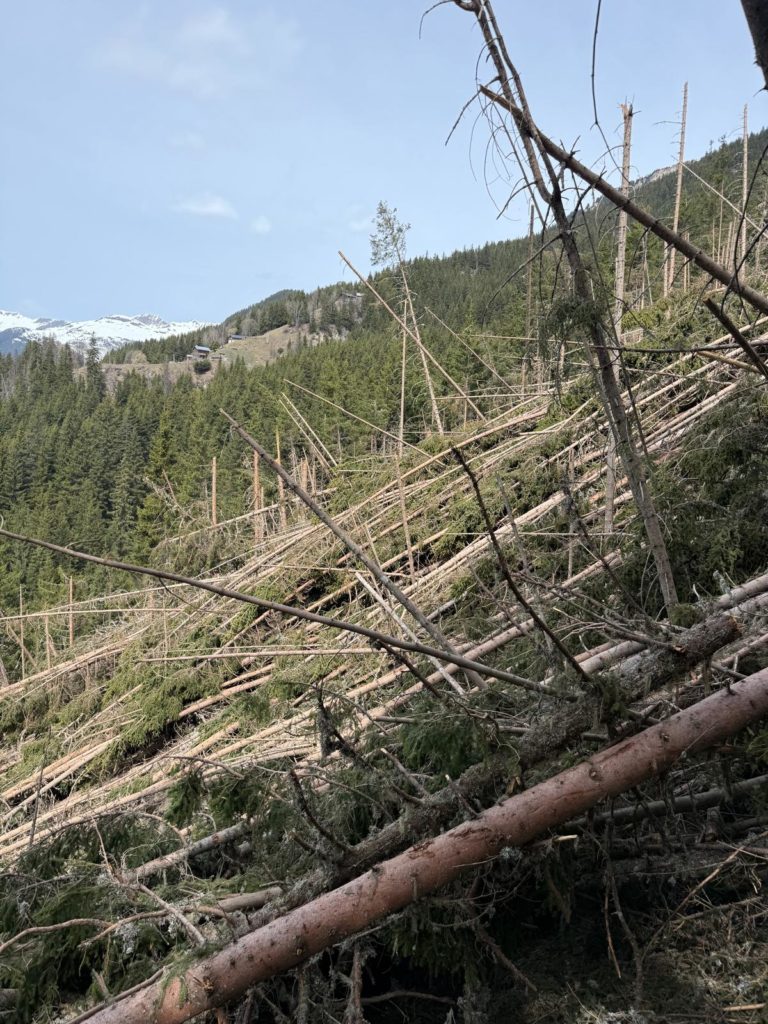 The trees felled by the winter avalanche. Image: Dominik Daul
And, meanwhile, the fallout from the recent fire is going to be felt for a long time to come. Roads that were closed have yet to reopen completely.
“It’s going to take a long time to secure the road,” Daul said. “So we have to deal with lights and alternate-traffic situations that will go way through the winter season until next year.
“The road being only passable on one lane for an extended period of time will complicate day-to-day life and create bottlenecks. Any kind of accident will – again – block access to Planay, Chamberanger and Pralognan, which is a concern for emergency services like ambulances and firefighters.
“The fire has weakened the cliffs above the road through the heat as well as the huge volumes of water dropped, creating a long-term risk for more severe rockfalls. The burned trees will lose their function as erosion control and avalanche protection.
“The one-way-use of the road plus the load of 450 concrete blocks will push the stress limits of an old mountain road that the département already has a hard time maintaining – there were already cracks and depressions in this section [of the road] before the fire.”
The concern, from someone who lives, works, and understands the area is understandable. “We live here all year,” Daul said. “We work here. We look after our neighbours. We check on the elderly. We water the village flowers when the commune staff are overwhelmed. We cook meals for firefighters. We keep these mountains alive.
“This is our home – not a museum, not a postcard, and not a place that only exists when people come on holiday.”