From the chancellor’s warning against US interference in upcoming state elections to the increasing pressures on Germany’s drinking water resources, here’s what we’re talking about at The Local this week.
This week German Chancellor Friedrich Merz gave his summer interview in a room packed full of journalists in Berlin. The annual press conference with the chancellor is a tradition in German politics, and is held just before the Bundestag breaks for the summer holidays.
Coming with an approval rating that is an all-time low for a sitting chancellor, Merz was eager to tout what he sees as his government’s recent successes – namely a number of reforms for work-life policies, social benefits, taxes and healthcare among other things.
But one less expected issue, with frightening implications, came up during the interview: a United States government backed grant program that some say could be used to boost the Alternative for Germany’s influence ahead of state elections in Saxony-Anhalt and Mecklenburg-Western Pomerania.
The US State Department says that its newly launched $3 million grant program is aimed at “defending democracy and human rights around the world”. But a report by The Guardian quotes a former state department official as saying the scheme is part of an “effort by the state department to put the thumb on the scale of elections in Europe”.
Asked about the issue, Merz noted that German law forbids political parties from receiving financing from abroad.
“For our part, we do not interfere in American elections,” he added. “Conversely, I do not want the American government or institutions close to the government to interfere in German elections.”
To what extent foreign actors – especially Russia – have been able to influence German politics has been a topic of concern for years. But to hear Germany’s highest politician warn against direct political influence from the US is a new development.
Merz has been increasingly, if still cautiously, critical of US President Trump in recent months. One notable instance was when he criticised Trump’s decision to launch an attack against Iran.
But Germany’s top leader is still reportedly very friendly with him in private settings.
Earlier this month at the NATO summit in Turkey, the chancellor and his wife Charlotte apparently had a lengthy chat with Trump over dinner.
Citing government sources, the German Press Agency reported that the three talked “the entire evening” about political and private topics. Also at the table were Turkey’s President Recep Tayyip Erdogan, NATO Secretary General Mark Rutte and Italian Prime Minister Giorgia Meloni. They ate beef ribs and sea bass with artichokes and vine leaves.
Where is this?
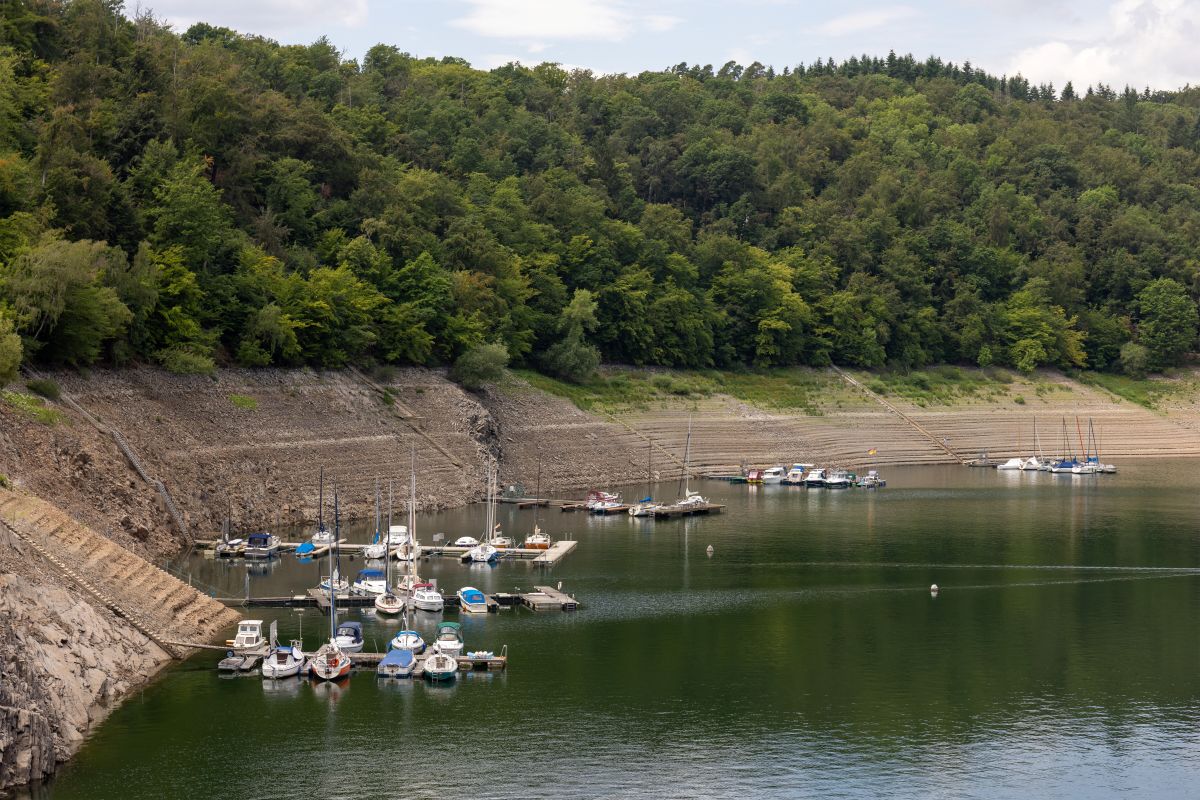
Photo: picture alliance/dpa | Christian Lademann
The above photo looks a bit like a scene from California, or another place where rain is scarce and reservoirs tend to run low. But actually this shot comes from the German state of Hesse.
Unfortunately water scarcity has become a real concern now in Germany and central Europe. Seasonal rain patterns have become less predictable whilst heatwaves have become more common due to human caused climate change.
Now some German cities are facing the threat of drinking water shortages. Environment Minister Carsten Schneider told Der Spiegel this week that the seriousness of the issue has so far been underestimated.
“In the future, we will have serious conflicts over water – also in Germany,” he said.
This week, the city of Munich took action to conserve its own drinking water supply — calling on residents to save water and issuing a decree that could see people fined for indulging in certain water-heavy activities, such as washing cars at home or watering gardens during daytime hours.
READ ALSO: No filling pools or watering lawns – Munich issues decree to save water
Meanwhile Germany’s Association of Cities says that 80 municipalities already need to issue similar decrees every hot summer.
At Kaub, a central point of the Rhine River in Germany, water levels on Wednesday were at a record low for this time of year. Already below the level needed for fully-loaded ships to pass safely.
So cargo ships are running with reduced loads on the river that carries about 80 percent of Germany’s inland water transport.
The above photo shows the jetties at Edertal-Edersee on July 16th. Interestingly, when the water levels in the reservoir fall, the remains of old villages that occupied the valley before the Eder dam was built appear. The former villages of Asel, Berich and Bringhausen are now referred to as ‘Edersee Atlantis’.