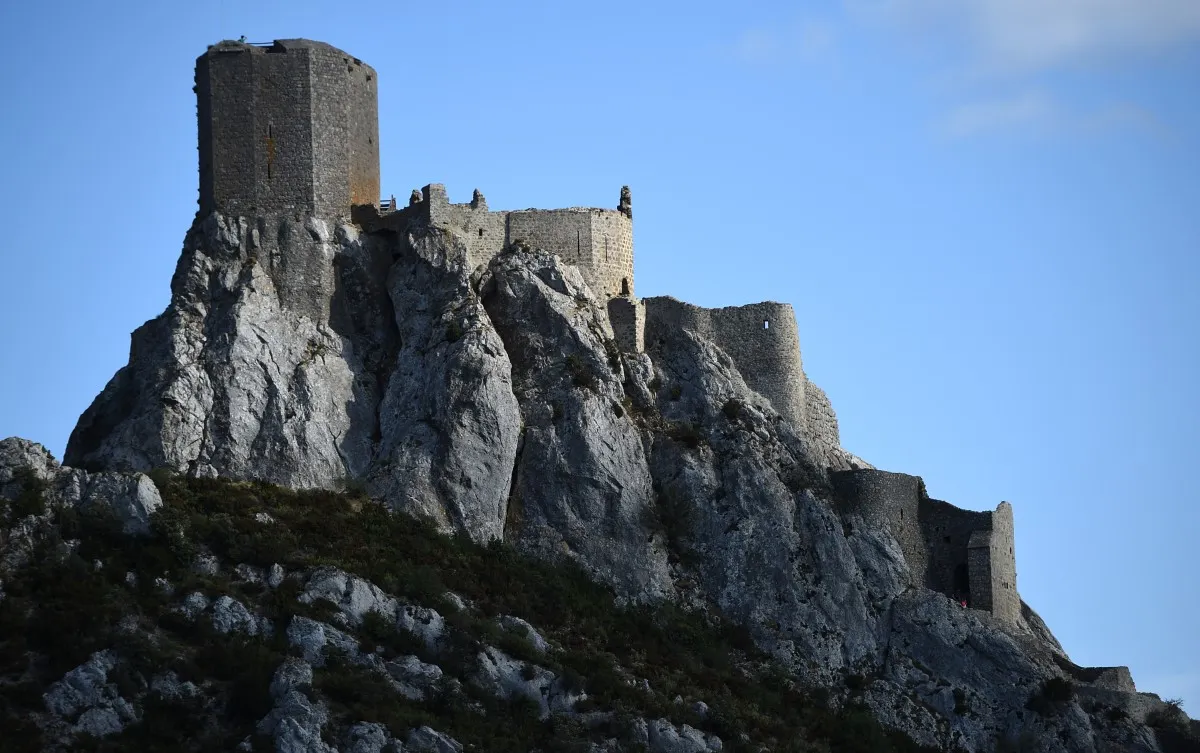
With France bidding to expand its list of UNESCO world heritage sites, an application for the stunning and mysterious Cathar castles of south-west France has stirred anger among locals, as Helen Massy-Beresford reports.
“Garderem los castéls Catars!” runs the slogan in the southern French Occitan language: “let’s keep the Cathar castles!”.
While France waits to find out if eight spectacular castles in the far south west of the country will be added to UNESCO’s World Heritage List, a vocal group of local people is worried that renaming them the Languedoc Royal Fortresses is a blow to local identity.
France is hoping that the group of mostly ruined castles, scattered over the rugged landscapes of the Aude and Ariège departments in south west France will, after a long-running deliberation process, be added to UNESCO’s list of World Heritage Sites, helping secure their future and boost local development too.
The decision is expected July 26th, along with the decision on a separate application for UNESCO status for the D-Day landings beaches in Normandy.
The candidature groups together the castles of Aguilar, Carcassonne (already recognised by UNESCO in its own right), Lastours, Montségur, Peyrepertuse, Puilaurens, Quéribus, Termes.
READ ALSO: 8 must-visit castles in south-west France
Announcing the bid in 2025, the French Interior Ministry said that the castles “illustrate a pivotal period in history and offer a unique example of military architecture, conferring on them an exceptional universal value”.
The castles are commonly known as the Cathar castles, but the bid renames them Languedoc Royal Fortresses, a decision made in the interests of historical accuracy, say the bid authors.
Contested history
The sites have long been associated with the Cathars, a mysterious religious group active in the region in the 13th century.
But the Cathars did not actually build the castles – King Louis IX ordered and commissioned them – and in the hope of winning over the UNESCO decision-making committee, the bid seeks to set the record straight.
Opponents, via demonstrations and petitions, say that even if the Cathars did not build the castles, their story is intricately linked to the sites, some of which provided refuge for the persecuted group. While they believe that UNESCO recognition would be a good thing, they think the region should not give up the Cathar legend to secure it.
In one protest on July 18th, a group of people braved the burning sun to scale the steep path to Quéribus castle, waving red and yellow Occitan flags and holding up their ‘Gardarem los castéls Catars’ banner.
For French authorities and local administration, securing World Heritage Status for the monuments is important to help protect and restore them, as well as the surrounding landscapes. The listing should also help drive tourism and economic development in these historically deprived areas of France.
The castles represent an important episode in medieval French history and are a striking example of military architecture, part of King Louis IX’s efforts to shore up his power in the region, establishing Carcassonne as a military and administrative centre, surrounded by a network of strategically positioned castles to protect the border with the Kingdom of Aragon.
Cathar country
Supporters of the bid see it as important to highlight the castles’ real role in military strategy of the time, but like the Cathars itself, the move is dividing opinion.
While the Cathars sought reincarnation after death as “Cathar perfects”, in life, they used the local Occitan language instead of Latin for preaching, and had a reputation for living a simple life and helping the poor and sick, making them popular among ordinary people in the region.
But they were denounced as heretics and persecuted for their beliefs by the French crown and the Catholic Church during the Albigensian crusade.
One of its bloodiest episodes was the 1244 siege at Montségur in Ariège, one of the sites in the UNESCO bid, where over two hundred Cathars were burned.
But if Montségur is closely linked in popular imagination with the Cathars, the vertiginous ruins that still stand there are from a fortification built after the massacre.
Over the years the Cathar story has been so embellished, and so few Cathar records remain, that it has taken on a life of its own, with a host of books and films tangling up the little solid historical fact with esoteric legend: everything from ancient astronomy to sorcery and curses, hidden treasure and the descendants of ancient religions.
READ ALSO: 22 of the biggest myths about French history
Perhaps the most famous myth is that the Cathars are the guardians of the Holy Grail – and a few escaped the Montségur siege to hide it.
The Cathar story has also become synonymous with the region: in Aude, one of France’s poorest départements, authorities have been using the “pays Cathare” label since the 1990s to attract visitors and promote everything from cassoulet to Corbières wine.
“Cathar Country” is now a key part of the area’s identity and that of the south of France, the formerly Occitan-speaking region.
If the bid is successful, the Languedoc Royal Fortresses will join an illustrious and varied list of UNESCO sites in France including Amiens Cathedral, the standing stones in Carnac, Brittany and the Pont du Gard Roman aqueduct as well as two sites in the Aude: the Canal du Midi, and Carcassonne’s world-famous fortified city.
But opponents of the rebrand argue that calling the sites the Royal Fortresses fails to capture their important role in forging the region’s distinct local identity.