
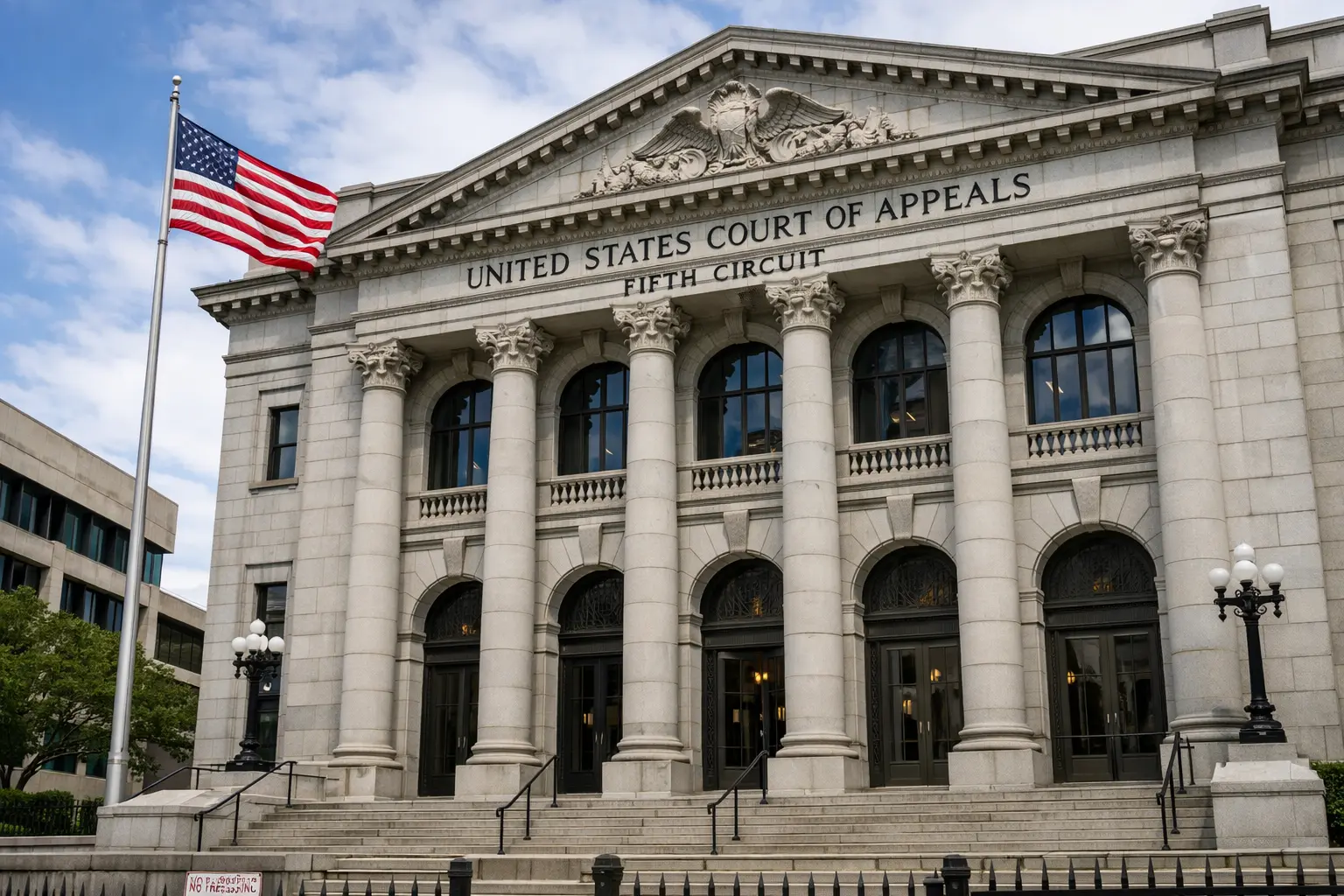
Fifth Circuit reverses habeas orders requiring bond hearings for some ICE detainees (Feb. 2026)
What happened and why it matters?
A divided U.S. Court of Appeals for the Fifth Circuit ruled on Feb. 6, 2026 that the federal government may keep certain noncitizens in mandatory detention without a bond hearing, reversing two Texas district-court habeas orders that had required bond hearings or release. The decision matters because it strengthens the government’s position that INA § 1225(b)(2)(A) can apply to people arrested inside the U.S. who are treated as “applicants for admission” because they were never “admitted” lawfully.
Key takeaways
- The Fifth Circuit reversed district-court habeas rulings that had ordered bond hearings (or release) for two detainees.
- The panel said § 1225(b)(2)(A) requires detention (“shall be detained”) for covered “applicants for admission,” and the detainees conceded they fit the statute’s “present… not admitted” definition.
- The ruling aligns with (and relies in part on) the BIA’s precedential reading in Matter of Yajure Hurtado. (Department of Justice)
- Practical impact is greatest in Texas/Louisiana/Mississippi (Fifth Circuit), and the broader national picture depends on other circuits and possible Supreme Court review. (Reuters)
Timeline
| Date | Milestone | What it means for readers |
|---|---|---|
| Sept. 5, 2025 | BIA: Matter of Yajure Hurtado | BIA says IJs generally lack bond authority for certain people held under § 1225(b)(2). (Department of Justice) |
| Feb. 6, 2026 | 5th Cir. decision filed | Reverses habeas orders; endorses broader mandatory-detention interpretation in these cases. |
| Not specified | Mandate / rehearing / further appeals | Whether anything pauses changes depends on procedural steps (uncertain; monitor docket). |
What changed vs. what didn’t
What changed
- Inside the Fifth Circuit, the government now has a stronger appellate decision supporting detention without bond under § 1225(b)(2)(A) for noncitizens deemed “applicants for admission” because they are present in the U.S. without having been admitted.
What didn’t change
- Congress did not amend the detention statutes; this is a court interpretation of how § 1225 interacts with § 1226. (GovInfo)
- The Supreme Court’s Jennings v. Rodriguez still controls key baseline statutory interpretations (e.g., that certain detention provisions “mandate detention” and do not themselves provide bond-hearing language), though the Fifth Circuit applies that framework to this dispute. (Justia Law)
Who is affected
This decision most directly affects:
- People detained in Fifth Circuit states (Texas, Louisiana, Mississippi), or moved into detention facilities there, whose custody is classified under INA § 1225(b)(2)(A). (Reuters)
- People arguing they should be detained under § 1226(a) (which can allow bond) rather than § 1225(b)(2) (which the government reads as no bond). (GovInfo)
Practical next steps (general info, not legal advice)
This is general information, not legal advice. If someone is detained and told they are not eligible for a bond hearing:
- Ask for the custody authority cited (e.g., “8 U.S.C. § 1225(b)(2)(A)” vs “§ 1226(a)”). (GovInfo)
- Track where the person is detained (state/facility) because venue and controlling circuit law can matter. (Reuters)
- Monitor whether there are new rulings in other circuits or Supreme Court filings that could change the legal landscape (uncertain timing). (Reuters)
Value-add module — Checklist: “No-bond under § 1225” (what to gather and ask)
Use this as a practical, non-legal triage list:
A) Gather (paper trail)
- Notice to Appear (NTA) and any custody paperwork showing the cited statute
- Proof of identity and any prior immigration paperwork (entries, applications, prior orders)
- Medical/humanitarian records if parole is later pursued (if applicable)
B) Ask (the 5 questions)
- What exact statute is ICE using for detention—§ 1225(b)(2) or § 1226? (GovInfo)
- Has an immigration judge said they lack bond authority because the case is under § 1225? (That’s the key consequence of this dispute.) (Department of Justice)
- Is the person being held in the Fifth Circuit (TX/LA/MS) or transferred there? (Reuters)
- Are there upcoming deadlines for hearings in removal proceedings under § 1229a?
- Has counsel evaluated whether any procedural challenges (including habeas options) remain viable under current circuit law?
C) Track (what can change fast)
- Docket updates: rehearing requests, mandate issuance, Supreme Court filings (uncertain; watch official dockets).
1) What did the Fifth Circuit do?
It reversed district-court habeas orders that had required bond hearings or release and remanded for further proceedings consistent with its opinion.
2) What is the key legal issue?
Whether people who are present in the U.S. but were never “admitted” can be treated as “applicants for admission” such that § 1225(b)(2)(A) mandates detention without bond.
3) How does this relate to the BIA’s Matter of Yajure Hurtado?
The Fifth Circuit discusses the BIA’s approach, which treated certain noncitizens present without admission as subject to § 1225(b)(2) mandatory detention (and thus outside IJ bond authority). (Department of Justice)
4) Is this automatically nationwide?
No. It is binding within the Fifth Circuit; other circuits may rule differently, and the Supreme Court could ultimately resolve a split. (Reuters)
5) Did Congress change the law in February 2026?
No. The decision interprets existing statutes (§ 1225 and § 1226) and reverses lower-court habeas relief. (GovInfo)
6) Does this end all bond hearings?
No. Many detained noncitizens fall under other detention authorities, and bond eligibility can depend on the statutory basis and case posture. (This ruling is about the contested § 1225 vs § 1226 classification in these cases.) (GovInfo)
Official Sources and References
- Fifth Circuit opinion (Feb. 6, 2026): Buenrostro-Mendez v. Bondi (and consolidated case).
- BIA: Matter of Yajure Hurtado (Sept. 5, 2025). (Department of Justice)
- 8 U.S.C. § 1225 (govinfo). (GovInfo)
- 8 U.S.C. § 1226 (govinfo). (GovInfo)
- U.S. Supreme Court: Jennings v. Rodriguez (2018). (Justia Law)
- Reuters coverage (Feb. 7, 2026). (Reuters)
- AP coverage (Feb. 7, 2026). (AP News)
- CRS overview: Immigration Detention: A Legal Overview. (Congress.gov)
Update Note
Updated on Feb. 8, 2026 to reflect the Fifth Circuit’s filed opinion and early reporting on next steps.