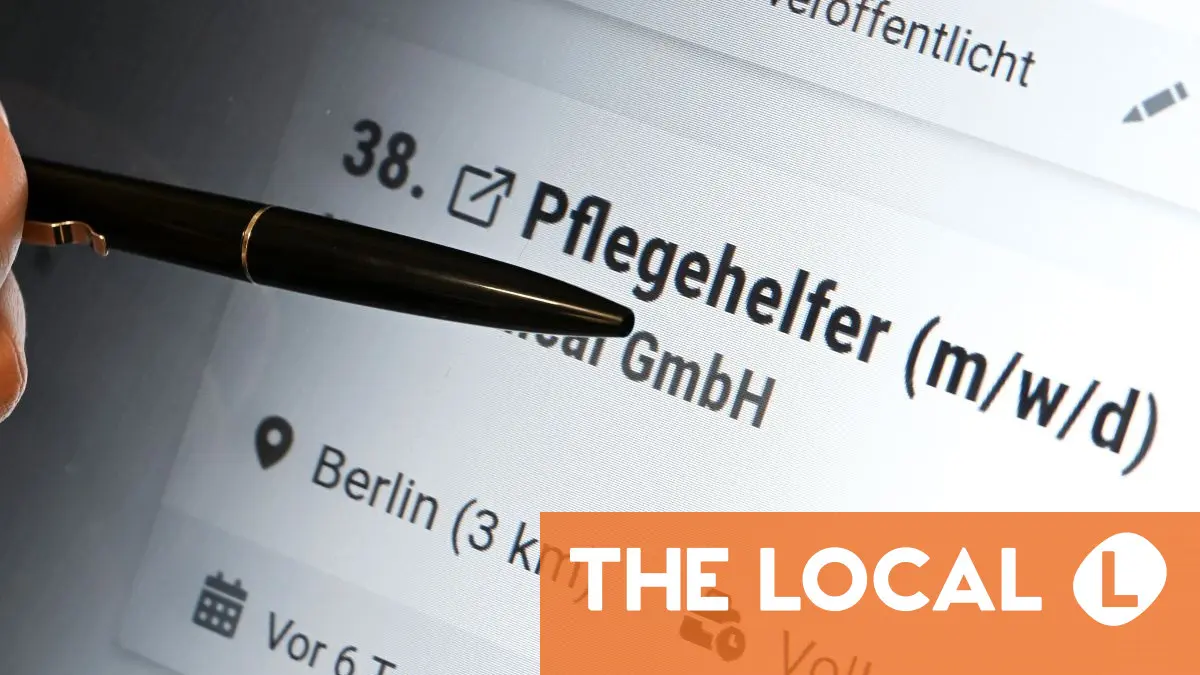

Receiving short term unemployment payments, or 'Arbeitslosengeld', comes with an obligation to regularly check the mail and respond to job offers. Finally, Germany's employment agency is moving the process online.
Germany's federal cabinet on Wednesday adopted a draft law to modernise and digitise unemployment processes.
The federal government expects the law to make the Federal Employment Agency (BA) more modern, with the aim of simplifying communication between the agency, unemployed people and companies -- and ideally getting benefit recipients placed into work faster.
What's changing?
A "digital first" principle is to be adopted in the job application process that people receiving unemployment benefits in Germany are subject to.
So going forward job applications are to primarily be submitted digitally via online forms with the Federal Employment Agency.
Unemployment registration is also to be primarily digital. The digital application for unemployment benefits is already being used by many, but this is to be made more user friendly.
An electronic application for short-time work allowance will also be mandatory for companies. This is for a benefit paid to employees whose working hours are reduced by their employers.
The government intends for the corresponding law change to be in place by the end of November.
What does this mean for unemployed people?
The switch to a digital first system may make the lives of people in Germany who have lost their jobs a bit easier.
In future, counselling sessions with the employment agency should be possible via video call provided that a personal interview is not necessary, according to information shared by the federal government. This is intended to make appointments more accessible, especially for jobseekers who are still in employment or have busy schedules.
Also, under the new digital system at least the physical walk to the mailbox would no longer be required.
Until now, unemployment benefit recipients were expected to constantly check their mail, and to react quickly when the employment agency sent a job offer. For this reason anytime spent away from home needed to be reported to the employment agency in advance.
Technically this requirement to report time away from home is to remain in effect. A report by Suddeutsche Zeitung quotes government officials as saying that "accepting reasonable work remains a duty," and that the law stipulates that one should react to job offers "promptly and locally".
That said, the process becoming primarily digital seems to imply that you could still react to a job offer promptly, even if you were to be away from your home at the time.
Reading between the lines a bit: Going full remote on your job search whilst receiving unemployment benefits would still likely be considered a breach of your agreement with the authorities. But the new digital process could make it possible to act on a notice from the agency if you happened to be away from home for a weekend.
The above report by Suddeutsche Zeitung notes that there are already numerous legal disputes about when and how unemployed people have to report moves.
Note that these changes specifically applies to short-term unemployment benefits, known as Arbeitslosengeld. It does not apply to long-term unemployment benefits, previously called Bürgergeld, which were recently adjusted and renamed Grundsicherungsgeld.
READ ALSO: How your eligibility for German citizenship can be affected by unemployment
Arbeitslosengeld is available to people who have worked a job in Germany subject to social security contributions for at least 12 months. A maximum of twelve months is paid out, or up to 18 months for workers over the age of 50. The monthly payment is set at 60 percent of your net salary or 67 percent for parents.