
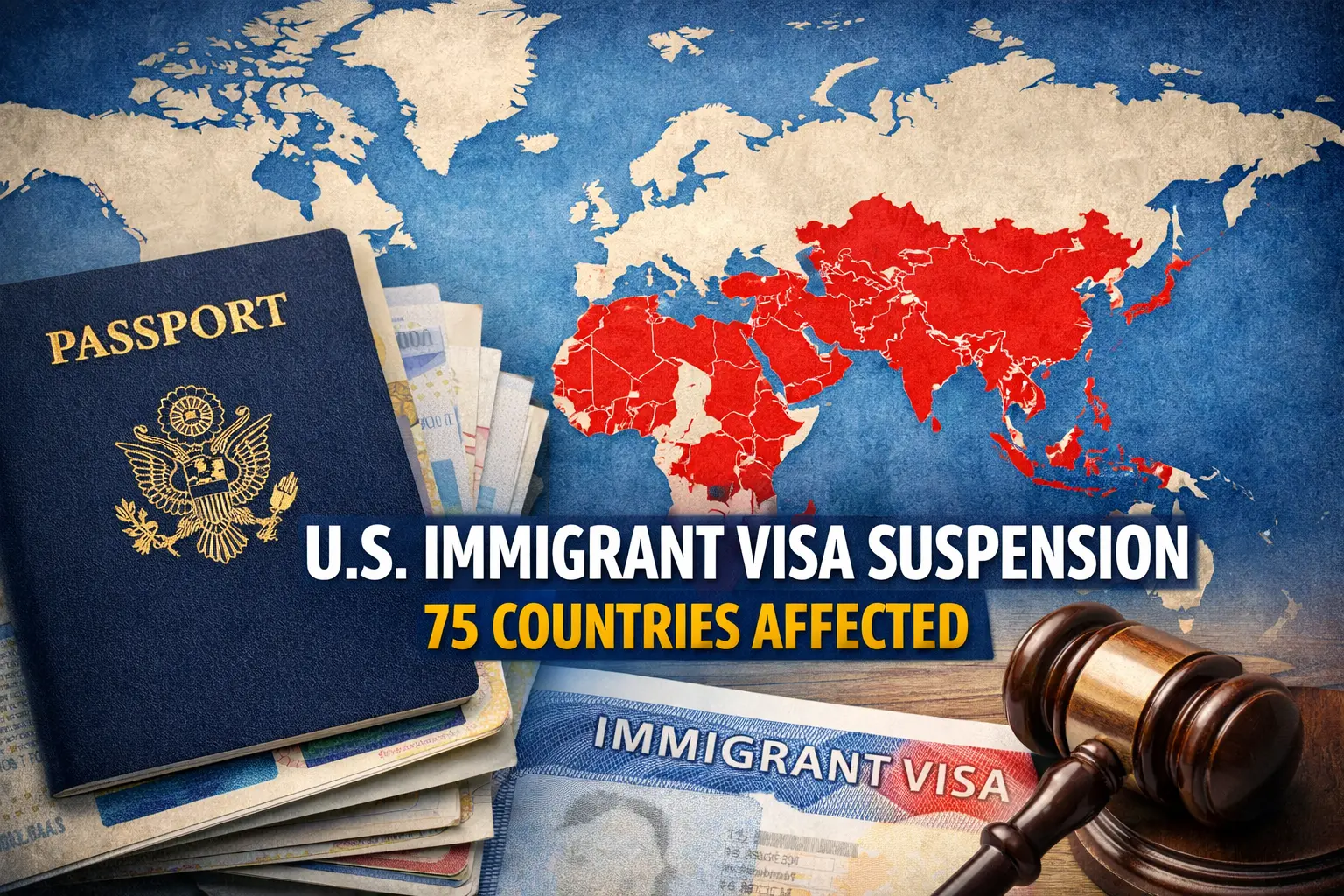
Who’s affected by the US immigrant visa pause for 75 countries, Jan. 21
Dek:
A new State Department directive pauses immigrant visa issuance for nationals of 75 countries while leaving tourist and other non-immigrant visas untouched.
Lede:
The U.S. Department of State says it will pause all visa issuances to immigrant visa applicants who are nationals of 75 countries, effective January 21, 2026, citing concerns about applicants becoming a “public charge” through reliance on U.S. public benefits. (Travel.state.gov)
Nut graf:
This is not a blanket travel ban, and it does not apply to visitors or other short-term visa holders. Instead, it targets people seeking to move to the U.S. permanently via consular processing, potentially affecting family reunification and employer-sponsored immigration pipelines across multiple regions. (Travel.state.gov)
Key takeaways
- The U.S. has paused immigrant visa issuance for nationals of 75 countries starting Jan. 21, 2026. (Travel.state.gov)
- Tourist visas and other nonimmigrant visas are not affected by this specific pause. (Travel.state.gov)
- Interviews may still be scheduled and attended, but visas won’t be issued for affected nationals. (Travel.state.gov)
- Dual nationals using a non-listed passport may be exempt, and some adoption cases can qualify for exceptions. (Travel.state.gov)
- The stated rationale is preventing “public charge” outcomes tied to public benefits reliance. (Travel.state.gov)
Which immigrant Visa is being paused, and what isn’t
Paused: immigrant visa issuance (permanent immigration via consulates)
The State Department’s notice says that visa issuance is paused for immigrant visa applicants who are nationals of the listed countries. (Travel.state.gov)
This primarily affects people pursuing:
- Family-based immigrant visas (spouses, children, parents, siblings of U.S. citizens; certain relatives of green card holders)
- Employment-based immigrant visas (many employer-sponsored green card pathways processed abroad)
- Potentially diversity visa winners who must receive immigrant visas through consular processing (how/if posts handle DV cases may vary by timing and guidance) (Travel.state.gov)
Note: The State Department notice is specifically about immigrant visa issuance at consulates. It does not describe changes to USCIS “adjustment of status” filings inside the U.S. (Travel.state.gov)
Not paused: tourist and other nonimmigrant visas (visitors, students, workers)
The State Department’s FAQ states the pause is “specifically for immigrant visa applicants,” and that tourist visas are not affected. (Travel.state.gov)
Reuters and AP similarly report that the policy does not impact visitor visas. (Reuters)
Who is affected: nationals of these 75 countries
If you are an immigrant visa applicant and a national of one of these countries, your case may proceed to an interview, but the visa won’t be issued while the pause remains in place. (Travel.state.gov)
The 75 countries listed by the State Department are:
Afghanistan; Albania; Algeria; Antigua and Barbuda; Armenia; Azerbaijan; Bahamas; Bangladesh; Barbados; Belarus; Belize; Bhutan; Bosnia and Herzegovina; Brazil; Burma; Cambodia; Cameroon; Cape Verde; Colombia; Cote d’Ivoire; Cuba; Democratic Republic of the Congo; Dominica; Egypt; Eritrea; Ethiopia; Fiji; The Gambia; Georgia; Ghana; Grenada; Guatemala; Guinea; Haiti; Iran; Iraq; Jamaica; Jordan; Kazakhstan; Kosovo; Kuwait; Kyrgyz Republic; Laos; Lebanon; Liberia; Libya; Moldova; Mongolia; Montenegro; Morocco; Nepal; Nicaragua; Nigeria; North Macedonia; Pakistan; Republic of the Congo; Russia; Rwanda; Saint Kitts and Nevis; Saint Lucia; Saint Vincent and the Grenadines; Senegal; Sierra Leone; Somalia; South Sudan; Sudan; Syria; Tanzania; Thailand; Togo; Tunisia; Uganda; Uruguay; Uzbekistan; Yemen. (Travel.state.gov)
Regional snapshot (from Reuters/AP coverage):
- Heavy impact across Africa, the Caribbean, the Middle East, South Asia, and parts of Latin America and Europe. (Reuters)
Who may be exempt from the Immigrant visa pause (and why)
The State Department FAQ lists key exceptions:
Dual nationals using a non-listed passport
If you hold dual nationality and apply with a valid passport from a country not on the list, you’re exempt from this pause. (Travel.state.gov)
Some intercountry adoption cases
The FAQ says children being adopted by Americans can qualify for an exception, including via a National Interest Exception pathway referenced in the notice. (Travel.state.gov)
What happens to interviews and cases already in motion?
Interview appointments can still happen
The State Department says affected nationals may submit applications, attend interviews, and it will continue to schedule immigrant visa interviews. (Travel.state.gov)
Current valid immigrant visas are not revoked (per State)
The State Department says no immigrant visas have been revoked “as part of this guidance,” and refers admission questions to DHS. (Travel.state.gov)
Practical impact: longer limbo, more uncertainty
Reuters reports consular officers were instructed to refuse certain cases that had reached late processing stages but were not yet issued, underscoring the “pause” as an operational stop rather than a simple slowdown. (Reuters)
Why the U.S. says it’s doing this: “public charge” risk
The State Department describes a review aimed at ensuring immigrants are “financially self-sufficient” and do not unlawfully utilize welfare or become a “public charge.” (Travel.state.gov)
AP reports the move is linked to broader guidance and screening around public assistance concerns. (AP News)
Critics, quoted by Reuters, argue the measure heavily restricts legal immigration, not just unlawful entry. (Reuters)
What we know / What we don’t know yet
What we know
- The pause starts Jan. 21, 2026, and applies to immigrant visa issuance for nationals of 75 countries. (Travel.state.gov)
- Tourist visas are not affected by this specific immigrant-visa pause. (Travel.state.gov)
- Interviews can continue, even if visas cannot be issued. (Travel.state.gov)
- Dual nationals using a non-listed passport may be exempt; some adoption cases may be exempted. (Travel.state.gov)
What we don’t know yet
- How long the pause will last (“paused” with no end date stated in the notice). (Travel.state.gov)
- Whether additional categories (or country lists) will be added/removed, and how consistently posts will implement edge-case scenarios (e.g., complex nationality questions). (Travel.state.gov)
What’s next (what affected applicants can do now)
- Confirm nationality rules in your case (especially if dual national). (Travel.state.gov)
- Attend scheduled interviews if instructed the State Department says interviews can continue even during the pause. (Travel.state.gov)
- Prepare stronger financial documentation if your case continues moving, as the screening focus is explicitly tied to self-sufficiency/public charge concerns. (Travel.state.gov)
- Monitor your U.S. embassy/consulate updates for post-specific operating procedures. (Travel.state.gov)
Timeline
- Jan. 14, 2026: Reuters/AP reports the administration and State Department outline the impending pause. (Reuters)
- Jan. 21, 2026: Effective date for pausing immigrant visa issuance for affected nationals. (Travel.state.gov)
- Feb. 2, 2026: State Department notice shows “Last Updated: February 2, 2026,” reiterating the list and FAQ. (Travel.state.gov)
FAQs
Does this stop tourist travel to the U.S.?
No. The State Department says the pause is for immigrant visas, and tourist visas (non-immigrant) are not affected. (Travel.state.gov)
If I’m from an affected country, should I skip my immigrant visa interview?
The State Department says applicants may attend interviews, and the Department will continue to schedule interviews. (Travel.state.gov)
Are already-issued immigrant visas cancelled?
The State Department says no immigrant visas have been revoked as part of this guidance. (Travel.state.gov)
What if I’m a dual citizen?
If you apply using a valid passport from a country not on the list, you may be exempt. (Travel.state.gov)
Why these countries?
The State Department and Reuters/AP reporting cite concerns that applicants from these countries are at higher risk of becoming a public charge / relying on public benefits, prompting a review of vetting and screening. (Travel.state.gov)