
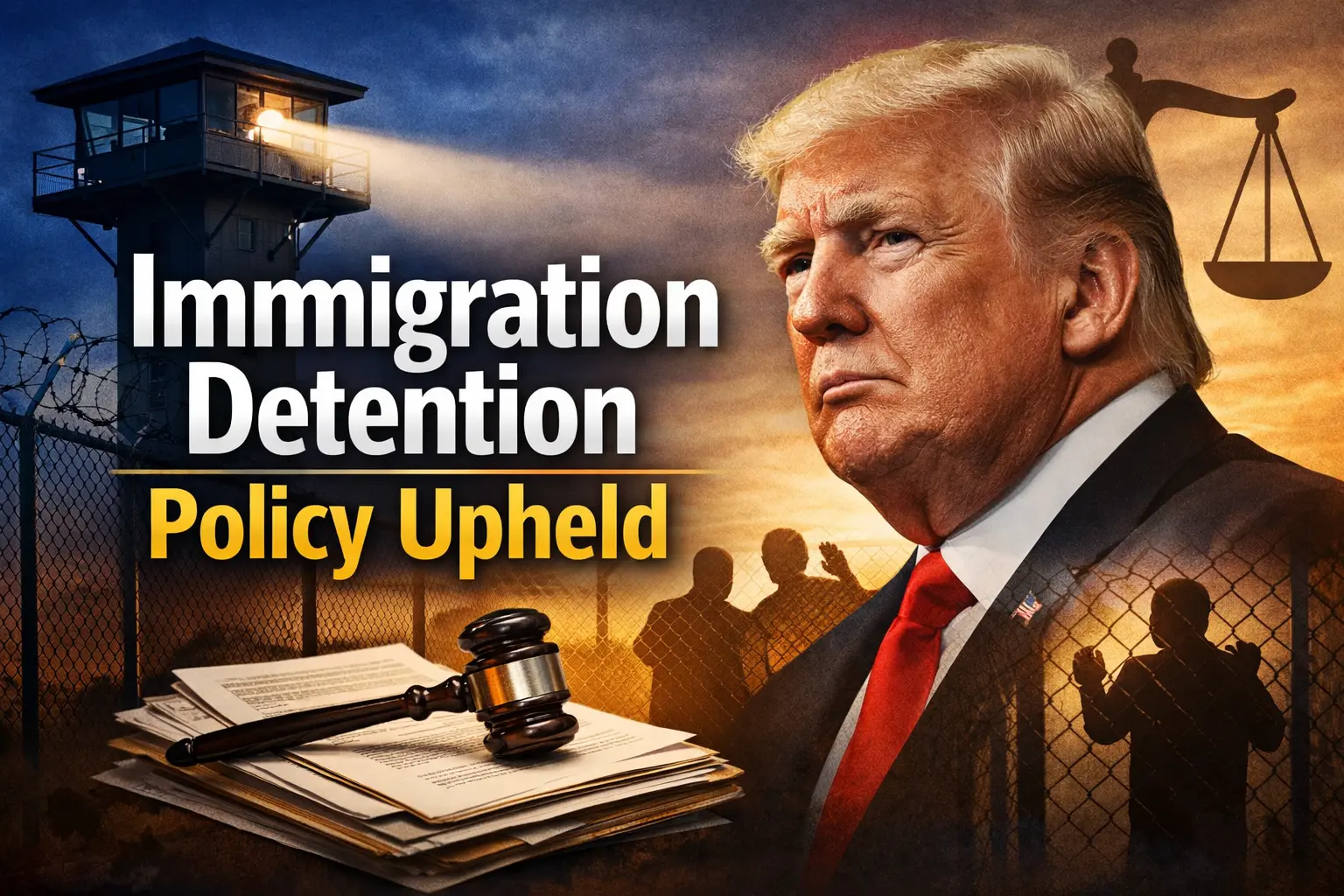
Appeals court upholds Trump detention policy, limiting bond hearings for migrants
Dek: A divided Fifth Circuit panel said the administration can treat many long-time undocumented residents as “applicants for admission,” triggering mandatory detention without immigration-court bond hearings. (Reuters)
Lede: The U.S. Court of Appeals for the Fifth Circuit ruled Friday, February 6, 2026, that the Trump administration may hold broad groups of ICE detainees in mandatory detention without bond hearings, reversing lower-court orders that had required bond proceedings for two Mexican nationals detained in Texas. (Reuters)
Nut graf: The decision—by a 2–1 panel—backs the administration’s reinterpretation of a 1996 immigration statute and is expected to affect thousands of detainees in Texas and Louisiana, where many immigration detention facilities are located. The issue is also moving through other courts, setting up a possible U.S. Supreme Court showdown. (Reuters)
Key takeaways
- The Fifth Circuit upheld mandatory detention without bond hearings for certain noncitizens arrested by ICE. (Reuters)
- The ruling hinges on who counts as an “applicant for admission” under 8 U.S.C. § 1225.
- DHS/DOJ can apply this interpretation even to people who entered unlawfully years ago, not just recent border arrivals. (Reuters)
- Release options narrow largely to discretionary “parole” decisions by DHS, not immigration-judge bond. (CBS News)
- More appeals are pending elsewhere, increasing the odds of Supreme Court review. (Reuters)
What the court decided
In the consolidated cases Victor Buenrostro-Mendez v. Pamela Bondi (No. 25-20496) and Jose Padron Covarrubias v. Miguel Vergara, et al. (No. 25-40701), the Fifth Circuit reversed district-court orders that had required bond hearings (or release) for two detainees.
Writing for the majority, Judge Edith H. Jones concluded the government’s reading of the detention statutes was correct and that the relevant law’s text supports mandatory detention for noncitizens who are “present within the United States who have not been admitted,” including those who entered unlawfully long ago.
Judge Dana Douglas dissented, warning the interpretation could extend mandatory detention to a vastly larger population than Congress expected. (Reuters)
The legal hook: “applicants for admission” and mandatory detention
At the center of the dispute are two provisions of the Immigration and Nationality Act:
- 8 U.S.C. § 1225(a)(1) deems an “alien present in the United States who has not been admitted” an “applicant for admission.”
- 8 U.S.C. § 1225(b)(2)(A) then says such applicants “shall be detained” while removal proceedings move forward—language courts often read as mandatory.
For years, many people arrested by ICE inside the U.S. were generally handled under 8 U.S.C. § 1226(a), which can allow bond hearings in immigration court. The administration’s shift argues that many of those people actually fall under § 1225 instead—cutting off bond hearings. (CBS News)
The Fifth Circuit majority emphasized that the statute’s wording doesn’t restrict “applicants for admission” to recent border crossers and that prior administrations choosing to detain fewer people does not remove the authority to detain more.
What changed before this ruling: the BIA decision DHS relied on
The Fifth Circuit opinion points to the Board of Immigration Appeals’ decision in Matter of Yajure Hurtado (2025), which concluded certain noncitizens who entered without inspection are subject to § 1225(b)(2) mandatory detention and are ineligible for immigration-judge bond.
That BIA decision—within the Justice Department’s immigration adjudication system—helped drive the policy shift that triggered a wave of federal habeas challenges across the country. (CBS News)
How big is the impact?
The Fifth Circuit’s geographic reach matters: it covers Texas and Louisiana, states with large detention footprints. Reuters and CBS both report the ruling is expected to affect thousands of people, and the Fifth Circuit opinion notes a surge in bond-related habeas litigation since DHS began detaining more people under § 1225(b)(2)(A). (Reuters)
The majority opinion also cites a New York federal decision that compiled hundreds of lower-court rulings that had gone the other way—illustrating the split that is now forming between trial courts and at least one appellate court.
What this means for detainees: bond vs. parole
Bond hearings: Under the upheld approach, many detainees cannot ask an immigration judge for release on bond under § 1226(a). (CBS News)
Parole: The opinion underscores DHS still has discretionary parole authority, but it is constrained to case-by-case decisions for urgent humanitarian reasons or significant public benefit. That puts release more in DHS’s hands than in immigration court.
Practical effect: For families and employers, the stakes are immediate—people who might have fought removal while living at home (after posting bond) could remain detained for months while their cases proceed. CBS reports the policy has resulted in detention of people who entered years or decades ago, including some without criminal records. (CBS News)
What we know / what we don’t know yet
What we know
- The Fifth Circuit upheld the policy and reversed two lower-court orders in the Buenrostro-Mendez and Covarrubias cases.
- The administration’s approach relies on treating many interior arrests as § 1225 “applicant for admission” cases, triggering mandatory detention. (Reuters)
- Other appellate courts are expected to address the issue soon, raising the odds of Supreme Court involvement. (Reuters)
What we don’t know yet
- Whether other circuits will agree or reject the Fifth Circuit’s statutory reading, creating a firm circuit split. (Reuters)
- How DHS will apply the ruling in practice (e.g., categorical guidance vs. individualized screening), beyond the legal standard announced. (CBS News)
- Whether the Supreme Court will take up the issue quickly—timing depends on how and when other cases reach it. (Reuters)
Timeline: how this got here
- 2025: BIA issues Matter of Yajure Hurtado, supporting mandatory detention under § 1225(b)(2)(A) for certain noncitizens present without admission. (Department of Justice)
- Feb. 3, 2026: Fifth Circuit hears arguments in the consolidated cases (per court calendar), with coverage noting a divided panel. (Fifth Circuit Court)
- Feb. 6, 2026: Fifth Circuit files its 2–1 decision, reversing lower-court orders and upholding the administration’s approach.
What’s next
Expect fast-moving litigation. Other appellate courts are already scheduled to consider related challenges, and if they disagree with the Fifth Circuit, the legal question may become ripe for Supreme Court review. (Reuters)
In the meantime, the ruling gives the administration a powerful precedent in Texas and Louisiana—and provides a blueprint other courts may be asked to adopt as similar cases multiply. (Reuters)
Does this ruling apply nationwide?
Not directly. It’s binding in the Fifth Circuit (Texas, Louisiana, Mississippi), but it may influence other courts. (Reuters)
Does it mean everyone arrested by ICE is “mandatory detained”?
The decision addresses a broad category—people “present” who “have not been admitted”—and upholds the administration’s ability to treat many such cases as § 1225 detention matters. How broadly DHS applies it remains a major practical question. (CBS News)
Can detainees still get out while fighting removal?
Possibly, but the pathway emphasized by the court is DHS parole (discretionary and case-by-case), not immigration-judge bond.