If you're vacationing in France's Brittany, you'll quickly notice that road signs, shop names and even restaurant menus often feature Breton words.
Don't worry - everyone in Brittany speaks French. You won't need to learn another language to order a crêpe or ask for directions.
But alongside French, Brittany has its own regional language: Breton, a Celtic language quite closely related to Welsh and Cornish. It arrived in Armorica (now known as Brittany) with migrants from the British isles between the fourth and sixth centuries.
Although the number of fluent speakers declined sharply during the 20th century as French became the language of schools and public life, Breton has never disappeared. Today it is taught in bilingual schools, celebrated through music and festivals, and remains visible throughout the region on bilingual road signs, business names and local traditions.
Here are 10 Breton words you're likely to come across during a visit.
Breizh (pronounced brayz)
Perhaps the first Breton word visitors encounter is Breizh, the Breton name for Brittany. You'll see it everywhere - from bumper stickers, T-shirts, beer bottles, bakery signs, to official branding.
You might also recognise it from the popular restaurant chain Breizh Café, serving Breton specialities including crêpes. Founded by chef Bertrand Larcher, the first Breizh Café opened in Tokyo, Japan, in the late 1990s, before the concept expanded to Brittany, with restaurants in Saint-Malo and Cancale, and later to Paris. The brand has since continued to grow, with a new location recently opening in Strasbourg in eastern France.
Demat (pronounced deh-mat)
The Breton greeting Demat simply means "hello". You'll occasionally hear it in shops, cafés and markets, particularly in areas where Breton culture is strongly celebrated.
It's a word that many locals use even if they don't speak Breton fluently, and it's an easy way for visitors to acknowledge the region's linguistic heritage.
Kenavo (pronounced keh-na-voh)
If someone says Kenavo, they're simply saying goodbye.
Literally meaning "until we see each other again". Shopkeepers sometimes use it instead of the French au revoir, particularly in more traditional parts of the region.
Fest-noz (pronounced fest nohz)
A fest-noz (literally "night festival") is one of Brittany's best-loved traditions.
These evening gatherings combine live traditional Breton music with communal dancing. Rather than performances to watch from the sidelines, a fest-noz invites everyone to join hands and learn the dances together.
One traditional dance particularly associated with the Morbihan département has a rather unusual feature: dancers form a circle and link themselves together by holding their neighbours' little fingers. It may look simple, but be warned - after a few rounds of energetic dancing, those pinkies can start to feel a little sore!
Recognised by UNESCO as part of the world's Intangible Cultural Heritage, the tradition remains hugely popular, with hundreds of events taking place across Brittany every year, especially during the summer and the fall.
[embed]https://www.youtube.com/watch?v=2D-3LamVWF4[/embed]
Ty (pronounced tee) Ker (pronounced kehr) and Plou (pronounced ploo)
If you're looking at place names or the signs outside cafés and guesthouses, you'll soon notice two recurring words: Ty (or Ti) and Ker.
Ty simply means "house". That's why names such as Ty Breizh (House of Brittany) or Ty Coz (Old House) are common for restaurants, holiday cottages and shops.
Ker means "place", "village" or "home", and appears in countless Breton place names like Kerlouan or Kervignac. Spotting Ker on a map is often a good clue that you're in Brittany.
Another Breton prefix that appears all over the map is Plou. Coming from the Old Breton word ploe (itself derived from the Latin plebs, meaning "people" or "parish"), it originally referred to a religious community or parish established around a church. Over time, it became a common element in Breton place names.
That is why you will find so many towns beginning with Plou- in Brittany, including Plouha, Ploumanac'h, and Plouescat.
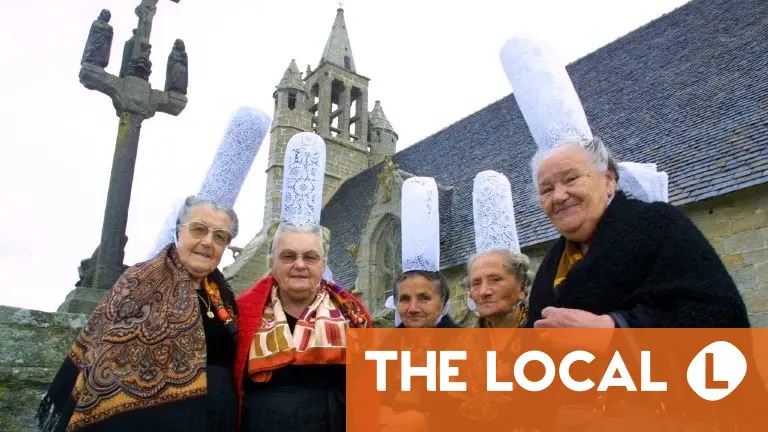
Bigoudènes (pronounced bee-goo-denne)
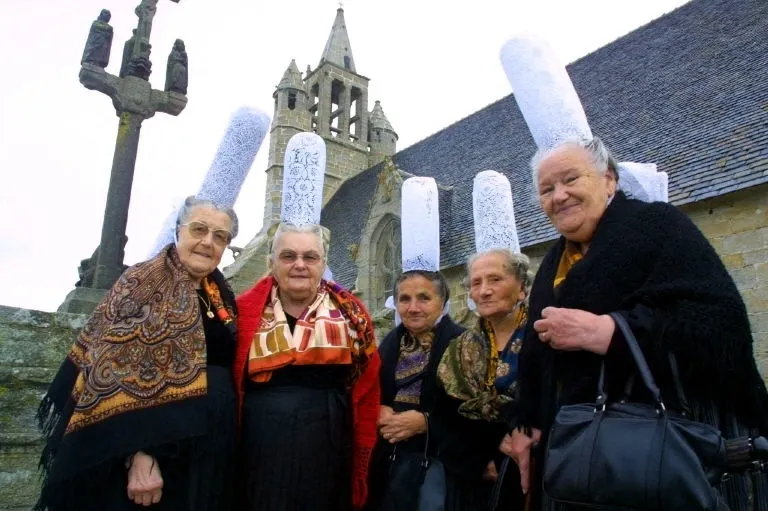
Originally, the term referred to women from the Bigouden region in southwest Finistère. Today, however, many people use it to describe the famous lace headdress worn there.
While you won't see many people wearing the towering white lace hats in everyday life anymore, they remain a symbol of Breton heritage and regularly appear during festivals and cultural events. Miniature Bigoudènes can also be found in countless souvenir shops throughout Brittany.
Yec'hed mat (pronounced yer-mat)
If you're raising a glass of Breton cider or enjoying a locally brewed beer, you might hear someone say Yec'hed mat!
Literally meaning "good health", it's the Breton equivalent of "cheers". The expression is especially common at festivals, fest-noz celebrations and family gatherings.
Mamm-gozh (pronounced mam gohz)
If you've spent time in Brittany, there's a good chance you've come across the name Mam Goz or Mamm-gozh, particularly on crêperies, food trucks and food products.
Mamm-gozh literally means "grandmother" in Breton. The spelling is often simplified to Mam Goz for branding purposes.
You may also come across THE Mam Goz, a much-loved Breton comic character created by illustrator Nikolaz Le Corre. Instantly recognisable by her traditional Bigoudène lace headdress, Mam Goz is portrayed as a sharp-witted, stubborn and fiercely proud Breton grandmother.
Through cartoons and illustrations, she humorously defends Breton culture, language and traditions while poking fun at everyday life in the region.