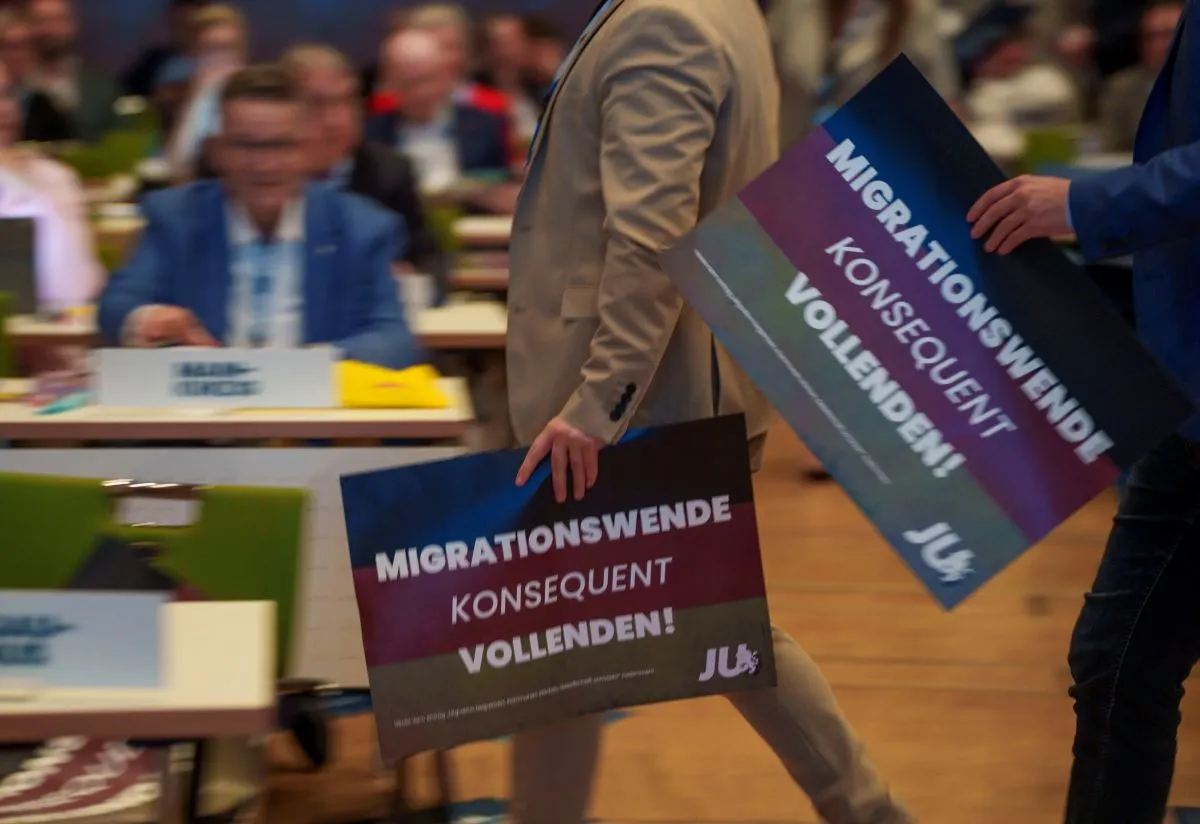
Conservative leadership has touted tighter migration policies as the answer to many of Germany’s problems, but a new study by the German Economic Institute says a ‘triple migration turnaround’ is threatening the country’s workforce.
Germany is now facing a “triple migration turnaround” that could make it harder to tackle chronic labour shortages, according to new research from the German Economic Institute (IW).
The employer-backed think tank said three separate immigration trends unfolding at the same time are resulting in a net loss of workers for Germany.
Together, the shifts have cut net migration down sharply. Citing figures from Germany’s statistics office (Destatis), the IW suggests net migration into Germany fell to 235,000 people in 2025, down from 663,000 in 2023 and the lowest level recorded since 2010, excluding peak years of the Covid pandemic.
For years, immigration has helped Germany offset persistent labour shortages due to its ageing population. In it’s newest study, first reported by the Rheinische Post, the IW argues that the latest figures show that the country’s traditional sources of new workers are beginning to dry up – so efforts to make Germany a more attractive place to live and work for skilled workers are now vitally important.
What is the ‘triple migration turnaround’?
The IW’s report use the phrase “triple migration turnaround” to sum up three separate immigration trends, which, taken together, are resulting in a sharp decrease in immigration to Germany.
The term ‘migration turnaround’, or Migrationswende in German, was increasingly used by centre-right politicians of the Union parties (CDU/CSU) starting around 2023 – 2024.
Calling for an end of the ‘Welcome culture’ politics that marked the Merkel era, more right-wing conservatives like now Chancellor Friedrich Merz and Bavarian Minister President Markus Söder championed the term, whilst campaigning for tighter border and asylum policies.
Fewer refugees
The first of the three changing trends is seen in the sharp fall in the number of people seeking asylum in Germany.
According to official figures, first-time asylum applications dropped from 329,000 in 2023 to 113,000 in 2025.
The biggest change came from Syria, where applications fell from around 103,000 to 23,000 during the same years. Notably, this was following the end of the Assad regime, in 2024.
Applications from Afghan nationals also more than halved during this time, from 51,000 to 24,000, while applications from Turkish citizens fell from 61,000 to 12,000.
The researchers stressed that the decline was not solely the result of Germany’s tougher immigration policies. Changing conditions, such as those in Syria mentioned above, have also played a significant role.
READ ALSO: What is Germany’s ‘migration turnaround’ actually achieving?
Meanwhile, Ukrainians continue to make up Germany’s largest single source of net migration according to the latest figures. Net migration from Ukraine fell from 116,000 people in 2024 to 89,000 in 2025, but it remained well ahead of other nationalities.
While refugees are not typically thought of as being incoming skilled workers, many do go on to enter the workforce and fill important jobs, including in hospitals and other vital service jobs.
EU workers leaving
The second shift concerned workers from newer EU member states – like Croatia, Romania or Bulgaria, for example – who had played a key role in Germany’s labour market over the past decade.
In October 2023, citizens from these countries accounted for around five percent of all employees in jobs subject to social security contributions. But that group has now begun to shrink.
In 2025, around 45,000 more EU citizens left Germany than arrived. Just two years earlier that number was completely flipped: in 2023 roughly 42,000 EU citizens had moved to Germany for work.
READ ALSO: Why are so many EU citizens planning to leave Germany?
According to the IW, this was unlikely to be a temporary development. As populations aged and economies improved in Central and Eastern Europe, fewer workers were expected to move west, while more and more will likely chose to return home.
The institute also pointed to declining migration from the Western Balkans, another important source of workers for sectors facing staff shortages.
More Germans are leaving
The third trend identified by the researchers was a rise in the number of Germans moving abroad.
The study found net emigration among German citizens increased from 74,000 people in 2023 to 97,000 in 2025.
Lead author Wido Geis-Thöne said the figures had not yet reached a critical level but described the nearly 30 percent increase over two years as “an indication of an unfavourable development”, or a clear warning sign in other words.
If more highly qualified professionals left Germany, he warned, the country risks worsening existing labour shortages while also weakening its capacity for innovation and long-term economic growth.
What about skilled workers?
Interestingly, despite the overall slowdown in immigration, the IW report suggests that immigration specifically linked to filling skilled jobs appears to be remaining relatively stable. Between the end of 2023 and the end of 2025, the number of residence permits issued for employment rose by 13.6 percent, while education-related permits increased by 15.3 percent.
However, the researchers cautioned that this could change if Germany’s industrial slowdown makes it harder for highly qualified foreign workers, particularly those in science, technology, engineering and mathematics (STEM), to find jobs that match the requirements of their visas.
To avoid future shortages, the authors of the IW report argue Germany should remain attractive to international talent by speeding up visa procedures, expanding legal labour migration pathways and limiting the tax and social security burden on skilled workers.
The institute said that Germany could not assume migration would continue to boost its workforce automatically – as demographic pressures reduce migration potential in many traditional source countries, attracting and retaining international talent are expected to become increasingly important in the years ahead.
READ ALSO: Germany’s housing crunch is driving away skilled foreign workers