Wildfires are frightening enough without the added challenge of trying to understand emergency information in another language. Whether you're following evacuation orders, listening to local radio or reading official updates, here's the essential French vocabulary to help you stay informed.
Wildfires (feux de forêt) are a longstanding feature of summer in France, particularly in the Mediterranean south. But as temperatures rise, wildfires are becoming more severe and are also happening in the centre and the north of the country.
If you live in, or are visiting, an area affected by wildfires, understanding the French vocabulary used by authorities, emergency services and local media can make an already stressful situation a little easier to navigate.
Here's a guide to the key words and phrases you may hear and come across.
READ ALSO: How to get the latest wildfire information and alerts in France
The basics
Feu de forêt - Forest fire or wildfire.
Incendie - Fire. While this can refer to any fire, you'll often hear incendie in news reports about major wildfires.
Départ de feu - The start of a fire. Authorities may report that a départ de feu has been spotted before it develops into a larger blaze.
Fumée - Smoke.
Flammes - Flames.
Broussailles - Scrubland or brush vegetation, where many fires begin or spread rapidly.
Embrasement - Blaze
Terrain difficilement accessible - This refers to areas that are difficult to access. You may see this term when a fire has erupted in the mountains, and firefighters are struggling to get it under control.
Fire risk levels
French weather forecasters regularly issue warnings about wildfire conditions.
Risque d'incendie - Fire risk.
Risque élevé / très élevé - High / very high risk.
Risque extrême - Extreme risk.
Vigilance - Alert or warning level. Local authorities may raise the niveau de vigilance when conditions become particularly dangerous.
Météo-France forecasters evaluate the risks by using colours: red is extremely high risk, orange high risk, yellow means mild risk and green means there is a low risk of a fire.
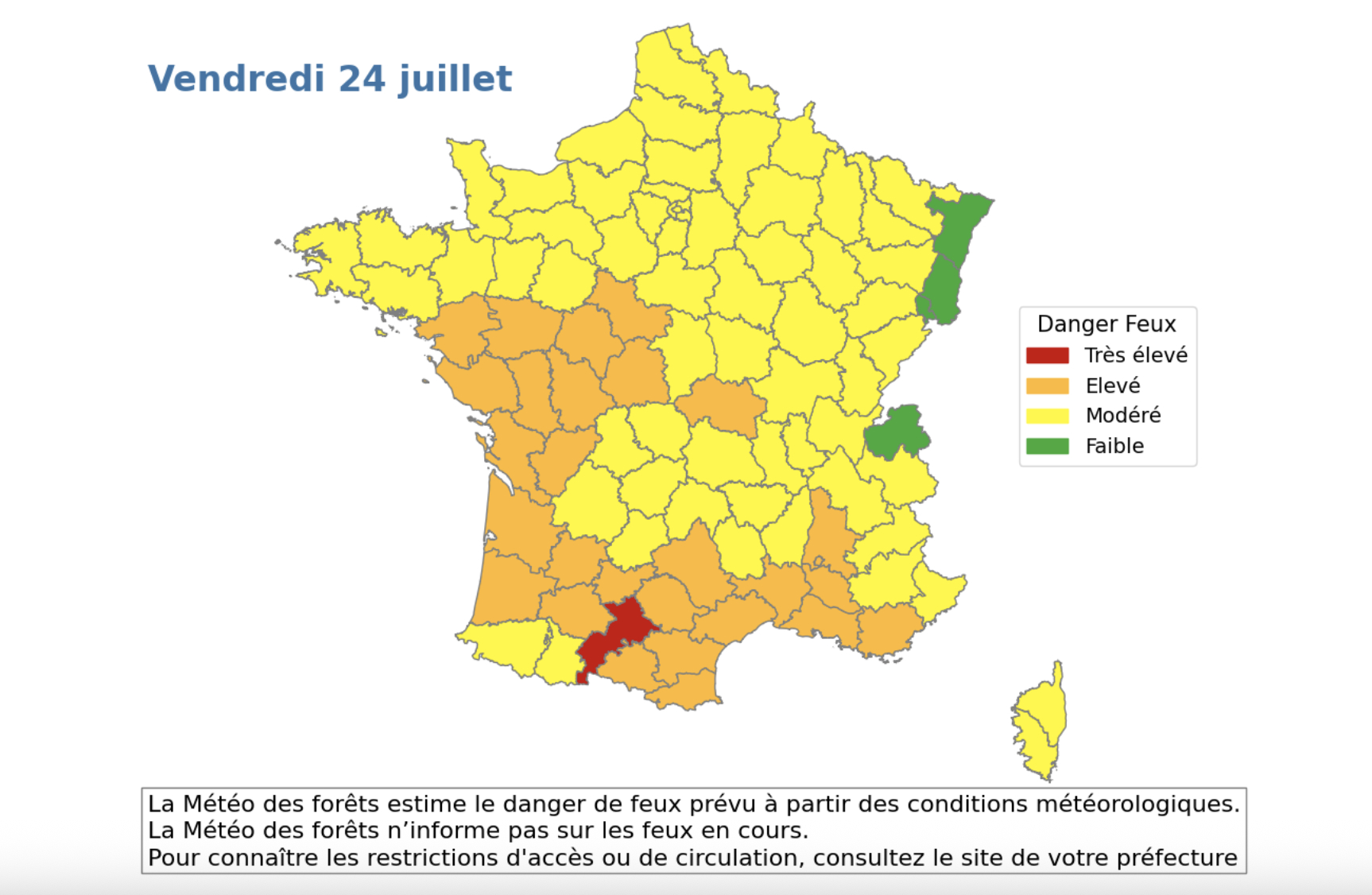 Example of Météo-France forecast for wildfire risk in the country. (Météo-France)
Restrictions you may encounter
When wildfire danger is high, prefectures often impose different restrictions.
Accès interdit - Access prohibited.
Fermeture des massifs forestiers - Closure of forest areas. In some départements, forests are closed to the public altogether on days of extreme fire risk.
Interdiction de faire du feu - Ban on lighting fires.
Interdiction de faire un barbecue - Ban on lighting barbecues.
Interdiction de fumer - No smoking. During periods of high risk, smoking in forests or natural areas may be prohibited.
If an evacuation is ordered
Emergency authorities may ask residents or holidaymakers to leave an area or, in some cases, remain where they are.
Évacuation - Evacuation.
Ordre d'évacuation - Evacuation order.
Ordre de la préfecture - Prefect order.
Évacuez immédiatement - Evacuate immediately.
Quittez les lieux - Leave the area.
Sortez de chez vous - Leave your home.
Restez à l'abri - Shelter in place. Sometimes it is safer to remain indoors than attempt to leave through smoke or approaching flames.
Confiner - stay indoors. This advice is sometimes issued if the air is very smoky.
Following official updates
You may hear these phrases on local radio, television or emergency announcements.
La situation est maîtrisée - The fire is under control.
Le feu progresse - The fire is spreading.
Le feu est fixé -The fire's spread has been halted, although it may not yet be extinguished.
Le feu est éteint - The fire has been extinguished.
Soyez vigilants - Stay alert.
Suivez les consignes des autorités - Follow the instructions of the authorities.
Useful words for travellers
If you're on holiday, these terms may also prove useful.
Camping évacué - Campsite evacuated.
Route fermée - Road closed.
Déviation - Detour.
Circulation interrompue - Traffic has been stopped.
Annulation - Cancellation.
Retard - Delay.
READ ALSO: 'Supprimé' to 'bouchons': Essential French travel words to know this summer
Emergency services
Several different emergency services are involved in tackling wildfires.
Les pompiers - Firefighters.
Les sapeurs-pompiers - The official term for France's firefighters.
La sécurité civile - Civil Protection, which coordinates emergency response and aerial firefighting resources.
Le préfet - The state's representative in each département, responsible for issuing emergency orders and restrictions. You may receive an order from the prefect to evacuate for example.
Ways to tackle a fire
These terms are used in the news to let people know how the wildfire is being dealt with.
Canadair - Water-bombing aircraft. Although originally a brand name, Canadair is commonly used in France for amphibious firefighting planes.
Avion bombardier d'eau - Water bomber.
Hélicoptère - Helicopter.
Tuyaux d'arrosage - Water hose.
Weather conditions that increase fire danger
Wildfires spread rapidly under certain weather conditions.
Canicule - Heatwave.
Sécheresse - Drought.
Vent violent - Strong wind.
Le Mistral - the name of a particularly strong wind associated with the south of France.
Rafales - Wind gusts.
These terms often appear together in weather forecasts warning of heightened wildfire danger.
What to do in case a fire starts
Météo-France has a few words of advice in case of a fire.
Alerter - If you spot a fire, call emergency services immediately on 112 or 18, or 114 for people with hearing impairments. The 18 number is for French firefighters, while 112 is the European emergency number, with multi-lingual operators including English-speakers.
Se protéger - Protect yourself and make sure to follow the orders from local authorities.
S'informer - Stay informed of the situation.
READ MORE: What you should do if there are wildfire warnings in your part of France