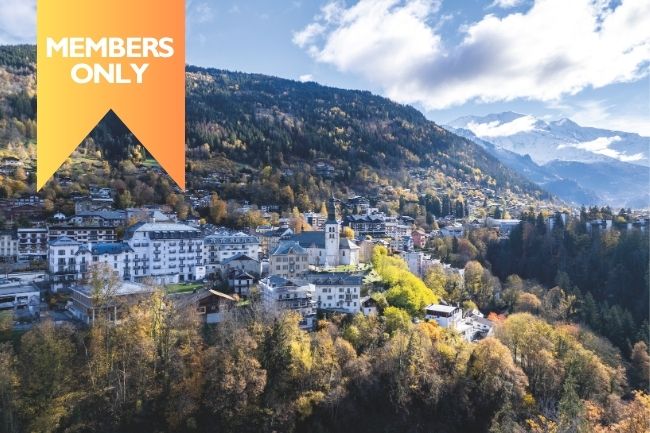
As spring arrived in the French Alps, Dominic Bliss visited Saint-Gervais-les-Bains, a town trying its utmost to attract visitors during all four seasons of the year.
They call it the shoulder season. It’s not the summer, when Alpine meadows buzz with hikers and bikers, and it’s not the winter, when snowsports dominate the slopes. Traditionally, the less popular spring and autumn months have been a dead period in the mountains, when resorts close their bars, restaurants and hotels, and locals tread water until the tourists return.
But one French mountain town, Saint-Gervais-les-Bains, is bucking the trend. This pretty town in Haute-Savoie is doing its utmost to attract tourists all year round even in the particularly low-key months of May, October and November.

Randonnee_sur_les_Cretes_en_direction_du_refuge_du_Mont-Joly-Fabian_BODET
Spearheading the campaign is the town’s mayor, Jean-Marc Peillex. He says that since the early 1900s, Saint-Gervais-les-Bains has enjoyed a healthy roster of visitors both in winter for the skiing (the town is now linked to the Evasion Mont-Blane and Les Houches ski areas) and in summer for the mountaineering and hiking.
But, in the old days, the only visitors during the shoulder season were sick patients seeking respite in the town’s thermal baths for their various skin conditions and respiratory ailments.
When Peillex became mayor in 2001, he struck upon a revolutionary idea. Instead of focusing purely on summer and winter sports-like the major ski resorts nearby, such as Chamonix and Megève he would attempt to make Saint-Gervais a year-round town, with life, community and activities on offer during all four seasons.
And he is convinced his strategy has worked. By loyally supporting local businesses, infrastructure, heritage and facilities, he has stemmed the labour migration that has blighted so many other Alpine towns and villages. “That’s the secret,” he says. “By encouraging children and old people and shopkeepers to live here all year round, we make sure there is always something going on. It’s not about tourists on one side and locals on the other. We’re all in it together.”

DOWN ON THE FARM
Peillex cites some impressive figures. He has been a local politician since 1983 and when he started, there were 4,500 inhabitants in Saint-Gervais and 5,000 in the neighbouring town of Megève. Nowadays, he says, there are 5,800 in Saint-Gervais and only 2,800 in Megève, with many Megèvans leaving in search of work elsewhere.
Peillex arranged for me to visit some of the businesses key to his town’s success. Up a steep road, southwest of the main town, I met Flavie Melendez, who runs La Ferme des Roches Fleuries, with 60 goats, 30 cows, two sheep and the tonnes of cheese she and her husband produce. In a large barn at the back, Flavie introduced me to her herd of goats. Guarding them faithfully were two huge Pyrenean mountain dogs, Thor and Athena. And they weren’t there just for show as, not long ago, the dogs’ mother had sadly been killed by a pack of wolves in search of fresh goat meat.
Flavie claims to be pro-Frexit, the French term for exiting the European Union. She believes extensive farming across the union means consumers are being tricked when it comes to the organic labelling of farm products. And she resents the way price limits are imposed on her own produce and the fact that larger farms within the union are given more financial aid per hectare than smaller farms like hers.

La Ferme des Roches Fleuries
A MOUNTAIN DISTILLERY
Higher up, to the east of town, I spent a few tipsy hours in the company of another artisanal producer, a Scotsman called James Abbott. Owner of La Distillerie Saint Gervais Mont Blanc, James moved to the Alps almost a decade ago and now produces gin, vodka, génépi and whisky in a former donkey hut. At 1,365m above sea level, it’s one of the highest distilleries in Europe. Originally from Kelso, in the Scottish Borders, James used to be a design engineer and mountain guide.
Gin is his favourite tipple, he says, served with a cube of ice and a “wee zest of orange or lime”. Most years he produces around 10,000 bottles of the stuff. “But deep down I’m a whisky lover,” he adds with a wink. Local restaurants and bars have embraced his spirits. The Michelin-starred chef Anne-Sophie Pic uses his gin in some of her dishes at her Megève restaurant, La Dame de Pic-Le 1920. But James is modest, choosing to hide his light under a bushel somewhat. I later discovered that he once met Emmanuel Macron, at the Elysée Palace in Paris, gifting him a bottle of his gin. It wasn’t clear whether the president of the Republic had yet imbibed of James’s distillation.
James now has plans to offer gin-making classes to the public. Despite his renown, he says profits have so far eluded him, describing his distillery as very much a labour of love. He hasn’t paid himself a proper salary yet but is hoping 2026 will turn his fortunes around.

A SPA DESTINATION
A much bigger Saint-Gervais business trying to turn a profit is the thermal baths, known as Les Thermes de Saint-Gervais Mont-Blanc. Here, there are indoor pools, outdoor pools, saunas, steam rooms and spa treatments, all within a lovely 10-hectare woodland park. Waters are drawn from a depth of 100m below the ground, emerging at a punchy 39°C. As the operators explain: “As it travels through the rocks, the thermal water absorbs a wealth of minerals and trace elements: sulphur, boron, silicon, manganese, strontium, lithium. It is 30 times more mineralised than ordinary drinking water, containing around 4,000mg of minerals per litre.”
It was a Swiss solicitor called Maître Gontard who, in 1806, first discovered the healing properties of these waters, buying up the land and initially building basic wooden baths above the springs. Doctors quickly appreciated the medical benefits of the sulphur-rich waters and hotels soon sprang up in the local town, luring in visitors with all sorts of skin and respiratory ailments.
But in 1892, disaster struck. The baths operators pick up the story: “On a sweltering summer evening, a torrent of mud, rocks and ice thundered down the mountain, sweeping away everything in its path. Around 100 people perished at the Thermes and the building was almost entirely destroyed. Several investigators explored the site and uncovered the cause of the catastrophe: over 200,000 cubic metres of water had accumulated over millions of years within the Tête-Rousse glacier, before rupturing its front section and cascading down into the valley.”

A TIMELESS PLACE
Over the following 130 years or so, gradual improvements were made to the site so that nowadays there are therapies, medical cures, all manner of spa treatments and general bathing. The site is open virtually the entire year, except for two short periods when they’re closed for maintenance. It’s further proof of Saint-Gervais’ year-round appeal.
But not everything here remains open throughout the year. This is France, after all. Eager to access higher altitudes, I took a ride on the famous Tramway du Mont-Blanc, France’s highest railway line, linking Saint-Gervais’ Le Fayet station to Mont-Lachat at 2,115m, with stops along the way.
Work is ongoing to extend the railway higher to a terminus at Nid d’Aigle at 2,380m. This electric tramway is used by sightseers, hikers, mountaineers and even the very boldest climbers gunning for the summit of Mont Blanc itself. At several stopping points, one can access the Tour du Mont-Blanc, a hiking trail that stretches for 170km around Mont Blanc, through France, Italy and Switzerland.
Unfortunately the tramway only operates in the winter and summer seasons, closing during spring and autumn, so there are no shoulder season adventures to be had here. I rode it in late September, a few days before it closed, all the way to Bellevue, at 1,800m. There I stood, not far from the railway, looking up at the mountains looming above. To the east, at 4,800m, was the summit of Mont Blanc, shrouded in autumn clouds. This, the most famous of Europe’s mountains, has been standing sentry here for hundreds of millions of years. Winter, spring, summer, autumn… it really doesn’t care what season it is.
From France Today Magazine