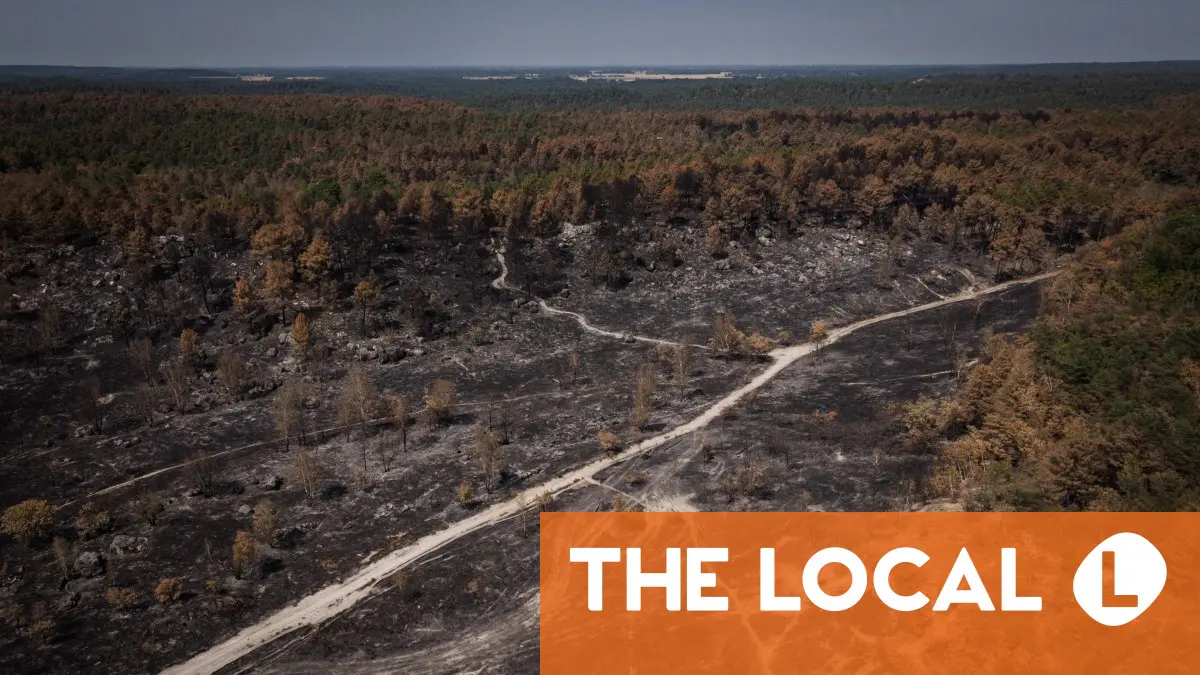
Whether it's due to an ongoing wildfire, or the high risk of fire, many of France's largest and most famous natural sites are currently closed to the public.
An order prohibiting public access to the historic Forest of Fontainebleau after two fires burned more than 2,200 hectares of land in mid-July has been extended until at least August 14th.
READ ALSO Wildfires that ravaged historic forest outside Paris contained
The Forest has been closed to visitors since the fires struck on July 13th, visitors arriving into the town of Fontainebleau by train are reminded of the closures in station announcements.
The Trois Pignons woodland, the state-owned forests of Fontainebleau, La Commanderie and Nanteau-Poligny, and the communal forest of Nemours, south of the capital, had been due to reopen on Monday, August 10th.
But the Seine-et-Marne préfecture announced on its website last week that, in view of the ongoing drought and heat, “the order prohibiting access to and use of the forest areas … is extended.”
This ban, which takes in Trois Pignons, the state-owned forests of Fontainebleau, La Commanderie, Nanteau-Poligny and the Nemours municipal forest, is “applicable to forest roads, hiking trails within all forest areas”.
The enforcement period, currently set to end after August 14th may be extended again, depending on conditions, with the risk of forest fires rising as France enters its fifth heatwave of the summer.
Fontainebleau is not the only natural park area in France with restrictions on public access because of the risk of wildfires, the Calanques natural park - close to Marseille - is also partially closed due to fire risk.
Every summer, from June 1st to September 30th, access to popular forest areas of the southern Bouches-du-Rhône département – known as the calanques – is regulated by a prefectural order to protect visitors and the natural environment from the risk of fire.
Every evening, local authorities assess and publish the fire risk for each individual forest area for the following day. In the event of a ‘red’ risk, access to the woodlands is prohibited.
At the end of last week, all calanques areas were closed to the public because of the fire risk.
On Monday, August 10th, four areas – Centre Var, Haut Var, Massif des Maures and Sainte Baume – remained closed to the public because the fire risk is considered to be dangerously high.
 Map of natural park restrictions in the Var departement. Graphic: Préfet du Var
The five other mountain ranges in the département and all others in the region are open to the public, including beaches and coastal paths in the Var and the Calanques National Park.
Access, however, is restricted to a number of hiking areas in the Alpes-de-Haute-Provence.
Access to the plage de Saint Julien on lac d’Esparron, for example, remains prohibited as it has since mid-July.
During the summer, the French weather forecaster Météo France gives a daily wildfire risk rating to each département in France.
On Monday, Météo-France forests forecast had 17 départements on heightened ‘orange’ alert for forest fires.
 Météo des forêts graphic for Monday, August 10th. Graphic: Météo-France
Its prediction for Tuesday places 32 départements on raised alert status.
 Météo des forêts graphic for Tuesday, August 11th. Graphic: Météo-France
During wildfire season, local authorities gain extra powers to ban access to areas - such as forests or natural parks - considered high risk.
They can also ban certain activities such as smoking or having a BBQ in high-risk areas, while local fireworks bans may be in place.
The best advice for visitors and tourists in particular areas is to keep up to date with local news, and check-in on the websites of départemental préfectures, which are updated regularly with locally specific information that is updated in real time.