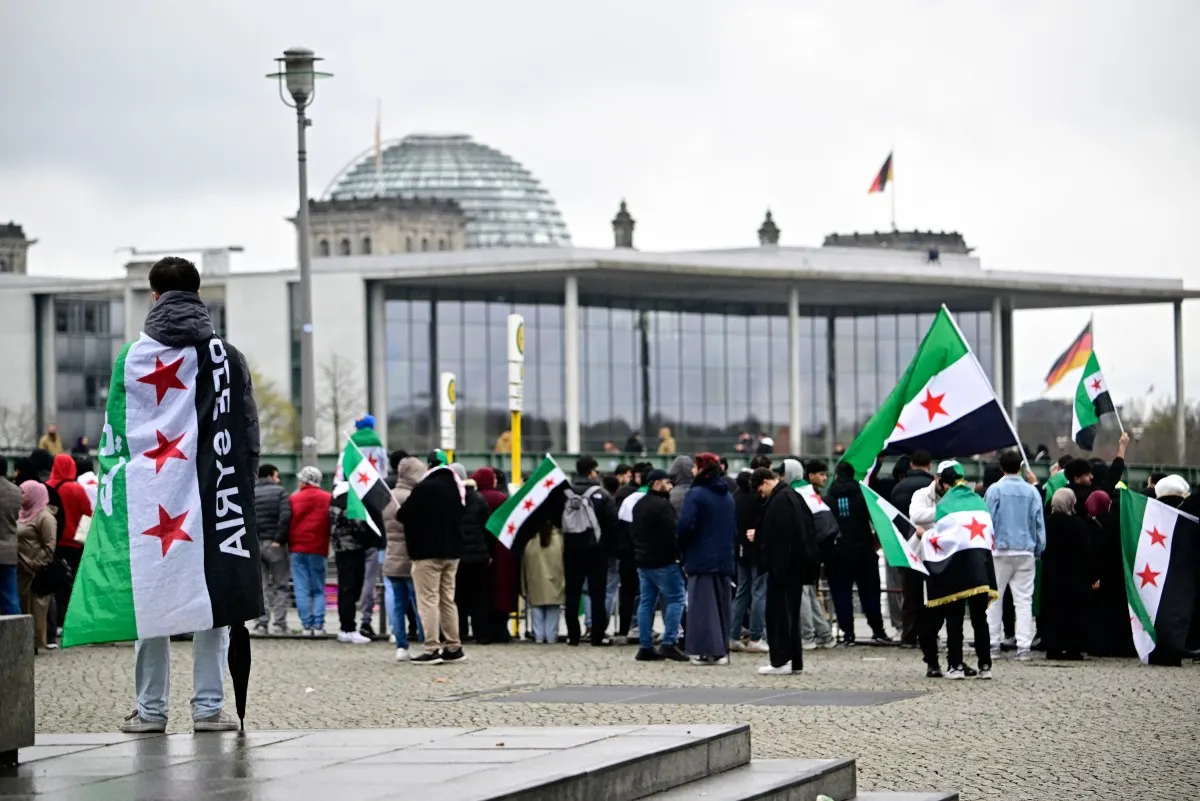
A survey across seven countries and territories in the Middle East and North Africa suggests Germany enjoys a surprisingly positive image. But respondents see the country as driven more by interests than ideals.
Germany is generally viewed favourably across much of the Middle East and North Africa.
That's according to a new survey conducted by the Konrad Adenauer Foundation, a German political foundation with close links to the conservative Christian Democrats (CDU).
In Syria 73 percent of respondents viewed the country positively, followed closely by Tunisia where around seven in ten respondents also expressed a positive view.
In Egypt, just over half of respondents held a favourable view, while approval was lowest in the Palestinian Territories at 38 percent.
Yet despite the overall goodwill, very few regarded Berlin as a major political actor in the region.
Economics over ideology
Perhaps the most surprising finding concerns Germany's relationship with Israel.
At a time when the war in the Middle East dominates headlines, observers might expect Germany to be viewed primarily through the lens of its close ties to Israel. The survey suggests otherwise.
Across most of the countries surveyed, respondents were more likely to associate German policy with economic interests than with support for Israel. Even in the Palestinian Territories, where Germany received its lowest approval rating, respondents more often pointed to political or economic interests as Berlin's main motivation.
READ ALSO: 'A new low' - Europeans no longer see the US as an ally and blame Trump
That does not mean views on Israel are unimportant. In every country surveyed except Morocco, respondents identified Israel as the greatest threat to regional security. Yet Germany was generally not perceived as a “one-dimensional ally” of the Israeli state.
The wider survey paints a picture of a region where pragmatism often outweighs ideology. Economic growth and unemployment were consistently identified as the most pressing challenges facing these countries and territories, while large majorities supported attracting more foreign investment.
Influence gap
The survey also highlights a broader challenge facing Europe.
EU countries tended to receive positive ratings across the region, but respondents rarely saw them as influential. Germany fits this pattern particularly well. In several countries, approval ratings were high while perceptions of German influence remained remarkably low.
The contrast is particularly striking in Syria and Tunisia. Although Germany ranked among the most popular foreign countries in both, only very small percentages of respondents identified Berlin as the most influential external actor in their own country.
In some cases, European neighbours such as France and Italy were seen as having greater political weight while also having lower approval ratings.
By contrast, regional powers such as Saudi Arabia, Turkey and Qatar were often seen as more influential.
The survey also found that China enjoys exceptionally high approval ratings across much of the region – and is similarly viewed as having limited political influence.
READ ALSO: 'Severely discriminated against' - Why do skilled immigrants leave Germany?
The survey was conducted by telephone between May and July 2026 among 8,475 people in Morocco, Tunisia, Egypt, the Palestinian Territories, Jordan, Lebanon and Syria.